
Brought to you by Dr. Roy Gretton, Journal Editor of The Nottingham Astronomical Society.
Please note, the NAS new permanent venue for our main meetings on the first Thursday in the month. Nottingham Emmanuel School, Gresham Park Road, West Bridgford, Nottingham, NG2 7YF.
Jupiter: The King Returns!
If that announcement seems a little over-the-top, we could put it another way and say that the largest of the planets, on its regular 12-year tour of the heavens, has now returned to the northern hemisphere, after spending the past six years in the south. This means that observers in the UK can begin to enjoy the best views of Jupiter that we have had since 2016. The giant planet will reach its highest positionon in our sky in 2026, but each year until then will see it climbing further north. This autumn it will be very noticeable as a bright creamy white “star”, shining with a steady light rather than twinkling, rising due east at 7:30pm in mid-September, and passing due south at 11:30pm in mid-October.
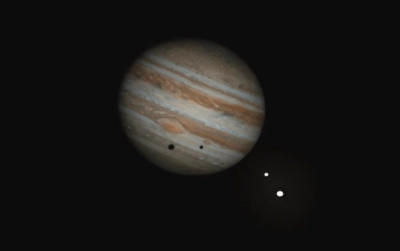
The Italian astronomer Galileo Galilei was the first person to turn a telescope on Jupiter, back in 1610. He famously discovered the four largest satellites of the planet: Io, Europa, Ganymede and Callisto. The largest of these, Ganymede, is actually bigger than the planet Mercury. Observing the movements of these four Galilean moons holds a particular fascinationon for amateur astronomers. Even with an ordinary pair of binoculars they are easy to spot, looking like small stars roughly in line with Jupiter’s equator. Although they number four, sometimes you can see only three of them, and sometimes only two. This is because they can pass behind the planet or directly in front of it, and so seem to disappear. To see the details of these events you will need a telescope of at least 100mm (4 inches) aperture. Several times per month it is possible to see a satellite AND its shadow passing across the face of Jupiter. On the evening of October 26th it will be possible to see two satellites throwing their shadows on to the cloud-tops of Jupiter at the same time. The image shows the view at 10:30pm that night: The right hand satellite is Ganymede, casting the lefthand shadow, and the left hand satellite is Europa, castng the right-hand shadow. The feature directly above Ganymede’s shadow is the famous Great Red Spot, a giant storm in Jupiter’s atmosphere that has been raging for centuries.
The US space agency NASA has an outstandingly successful space mission called Juno currently flying around Jupiter. It was launched from Earth in 2011 and arrived in orbit around the giant planet in 2016. Back in April this year it dared to descend to a mere 2050 miles above Jupiter’s cloudtops, whizzing over them at 131,000 mph. With the help of similar spacecraft we now know that Jupiter has nearly 80 moons, most of them far too small to be seen with Earthbased telescopes. Juno’s mission, originally designed to last five years, has now been extended until September 2025, so researchers will continue to benefit from the stream of data from the spacecraft for years to come.
The Night Sky in September & October
As regards prospects for observing the other planets this autumn, Mercury puts in a fleeting appearance in the morning sky in the first half of October, but won’t be at all easy to see. Venus disappears into the dawn glow in September but will emerge into the evening sky before the end of the year. Saturn is visible to the south in the evening throughout the autumn, though not particularly prominently, but it is distinguishable from the surrounding stars in the fact that it doesn’t twinkle. Jupiter we have already dealt with, leaving Mars, which will be coming to prominence by the end of October, when it will be high in the constellation of Taurus. In the first week of October it will be rising at 9pm, shining with an orange hue and getting brighter night by night.
Meteors
The best display this autumn is expected from the Orionids, for which maximum activity is anticipated on the almost Moonfree night of October 21st-22nd. These are swift-moving shooting stars which can leave trails that persist several seconds, best seen after midnight.
Phases of the Moon
| Sept | Oct | |
| First Quarter | 3rd | 3rd |
| Full Moon | 10th | 9th |
| Last Quarter | 17th | 17th |
| New Moon | 25th | 25th |

