

What started out as a planned act of habitat creation has grown into one of the largest sand martin nesting sites in central England.
Few people would associate a granite quarry with a breeding ground for wildlife, but for nearly 20 years, Mountsorrel Quarry has been quietly providing a safe haven for one of Britain’s most distinctive spring and summer visitors: the sand martin.
Sand martins, the smallest bird in the swallow and martin family, naturally nest in riverbanks, burrowing into vertical faces to create their homes. Quarry environments can offer exactly the right conditions, but most sites avoid encouraging them, as birds nesting in an active face can bring extraction in that area to a halt. At Mountsorrel, we’ve taken a different view.
BUILDING THE PERFECT NEST
Every March, we set aside some of our stockpiled material and create a dedicated vertical face specifically for the birds. Later that month, the sand martins arrive. In most cases, conservationists create faces with pre-made nest boxes to encourage the birds to stay. What makes our approach a little different is that the birds do the hard work themselves, as they burrow their own holes.
SUPPORTING RECORD NUMBERS
This season, ecologists from Baker Consultants recorded 420 active nests – around 100 more than last year. With sand martins capable of raising two or three broods, the site is supporting a significant number of birds over the course of a season.
RINGING THE BIRDS
Sand martins are loyal birds. Year after year, they have returned to the quarry and diligently rebuilt their nests. This reliable return has enabled us to start a programme of monitoring and research.
To better understand the birds’ movements, a team of volunteers, working under licence from the British Trust for Ornithology (BTO) – the governing body for bird ringing in the UK – visited the site to catch and ring birds.
In total, 105 birds were caught. Six already carried rings from previous captures, including a couple traced back to nearby Rutland Water, which is home to around 900 man-made nests and is considered one of the largest nesting sites in the UK. Some of those returning birds had first been ringed two or three years ago, giving a real sense of just how established this migration route has become.
The BTO is hoping to run a research project at Mountsorrel Quarry in the coming years, with a preliminary study taking place this summer to estimate the survival rates of adult sand martins. The scheme requires at least 125 adult birds to be caught or re-sighted each breeding season.
Lead volunteer, Eleanor Wilkins commented: “Our morning at Mountsorrel was fantastic! It was amazing to see so many adults on the wing at their breeding colony”. The team also returned in July to catch and ring more birds.
FOLLOWING THE SEASONS
The birds typically arrive in March and leave for warmer climates, including eastern and southern Africa and South America, in September. Once they’ve gone, we carefully clear the old nesting material and then, at the start of March, rebuild the face ready for their return. The BTO is considering extending its involvement next year, with longer monitoring periods to better understand breeding cycles and track individual birds over time.
Given the scale of what we’ve recorded here, Mountsorrel Quarry is now considered one of the largest sand martin nesting sites in the UK – something we’re very proud of.
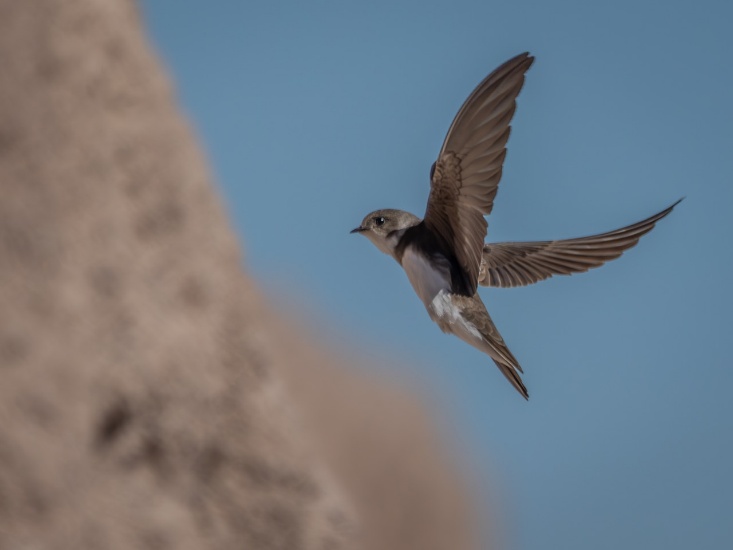
We invited a local wildlife photographer Martin Cooke to capture the birds in action, and we’re delighted to share some of his stunning photos.

GET INVOLVED
You can find out more about what goes on at Mountsorrel Quarry by visiting Mountsorrel.tarmac.com. If you would like to contact the team, please email mountsorrelquarryfeedback@tarmac.com.

