
Volkswagen has tweaked its ID.3 hatchback, but can it compete against newer rivals? Ted Welford finds out.
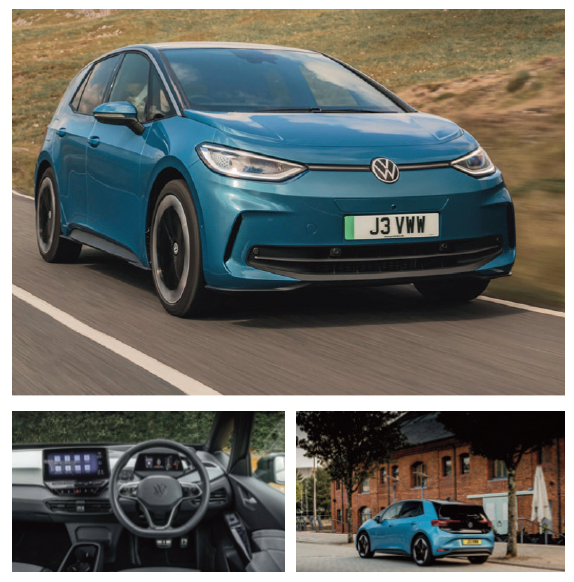
What is it?
Volkswagen’s ID.3 was meant to signal a new era for this German firm, but despite being built around specific EV underpinnings and with lots of added technology, the ID.3 had a lukewarm reception. So is this upgraded ID.3 worth considering?
What’s new?
On looks alone, not a huge amount seems to have changed, though Volkswagen’s aim was to make the ID.3 look more ‘grownup’. It’s inside where the bulk of the differences occur. The touchscreen has new software, while the cabin quality is improved.
What’s under the bonnet?
The two available ID.3 versions are the Pro and the Pro S. The former uses a 58kWh battery with a claimed range of 266 miles, while the latter gets a bigger battery that Volkswagen claims 347 miles for. Each uses the same 201bhp electric motor, sending drive to the rear wheels. Accelerating to 60mph takes 7.7 seconds, with a maximum of 99mph. The ID.3 can charge at up to 170kW, meaning a quick charger can theoretically give an 80 per cent charge in just half an hour.
What’s it like to drive?
The ID.3 drives very well, and even on our test car’s large 20inch alloy wheels the ride was surprisingly compliant, though the standard 18inch rims will give maximum comfort.
It handles well and we think there’s potential for a sportier ID.3 with a chassis as good as this. This Volkswagen lacks some of the immediacy of rivals while accelerating, but is more than fast enough.
How does it look?
An obvious change is the removal of the gloss black strip at the top of the bonnet. There are new diagonal air inlets in the front bumper too, and two new colours.
What’s it like inside?
The ID.3’s cabin looks largely unchanged but new soft-touch materials really help lift the interior. Interior space is impressive, with more rear seat space than a Golf, while the boot measures a useful 385 litres.
What’s the spec like?
As standard, the ID.3 comes with plenty of equipment, including adaptive cruise control, ambient lighting, wireless phone charging and a teninch touchscreen. Volkswagen says a completely new screen will arrive in 2024, and we feel the firm should have waited until then to introduce this new ID.3. The ID.3 starts from £37,115 for the standard battery or £42,115 for the Pro S. The many options can quickly increase the price – our test car came in at over £50,000 thanks to options like a Driver Assistance Plus Pack (£2,095) and an Exterior Pack (£1,725), which looks extortionate. The ID.3’s main problem comes in the form of the MG4. In ‘Extended Range’ form it’s better equipped, nearly as roomy and as good to drive, but costs £6,000 less than the Volkswagen.
Verdict
This relatively small ID.3 update improves this hatchback. The higher-quality interior is the best change, but with good driving dynamics and impressive practicality this Volkswagen remains one of the finest electric hatchbacks available. However, if Volkswagen is to really take the fight to firms like MG, the price must come down.

